How Is Lace Trim Made? Inside the Raschel Warp Knitting Process
Most buyers see lace trim for the first time as a finished sample: a dyed, softened, dimensionally set strip of lace lying on a table. Everything that decides its quality — how even the pattern is, how stable the width is, how consistent the repeat — was decided long before that sample reached the table.
This article walks through how lace trim is actually made, from yarn to packed roll. It is written for buyers and product developers who want to read a supplier's process, not just a supplier's catalogue — and to understand why the same design drawing can be quoted at two very different prices without either supplier being dishonest.
What Lace Trim Actually Is
Lace trim is a warp-knitted product. It is produced on multi-bar or jacquard Raschel warp knitting machines, using chemical fibre yarns such as nylon, polyester, spandex and viscose, natural fibres, and sometimes metallic yarns.
The industry draws two practical distinctions:
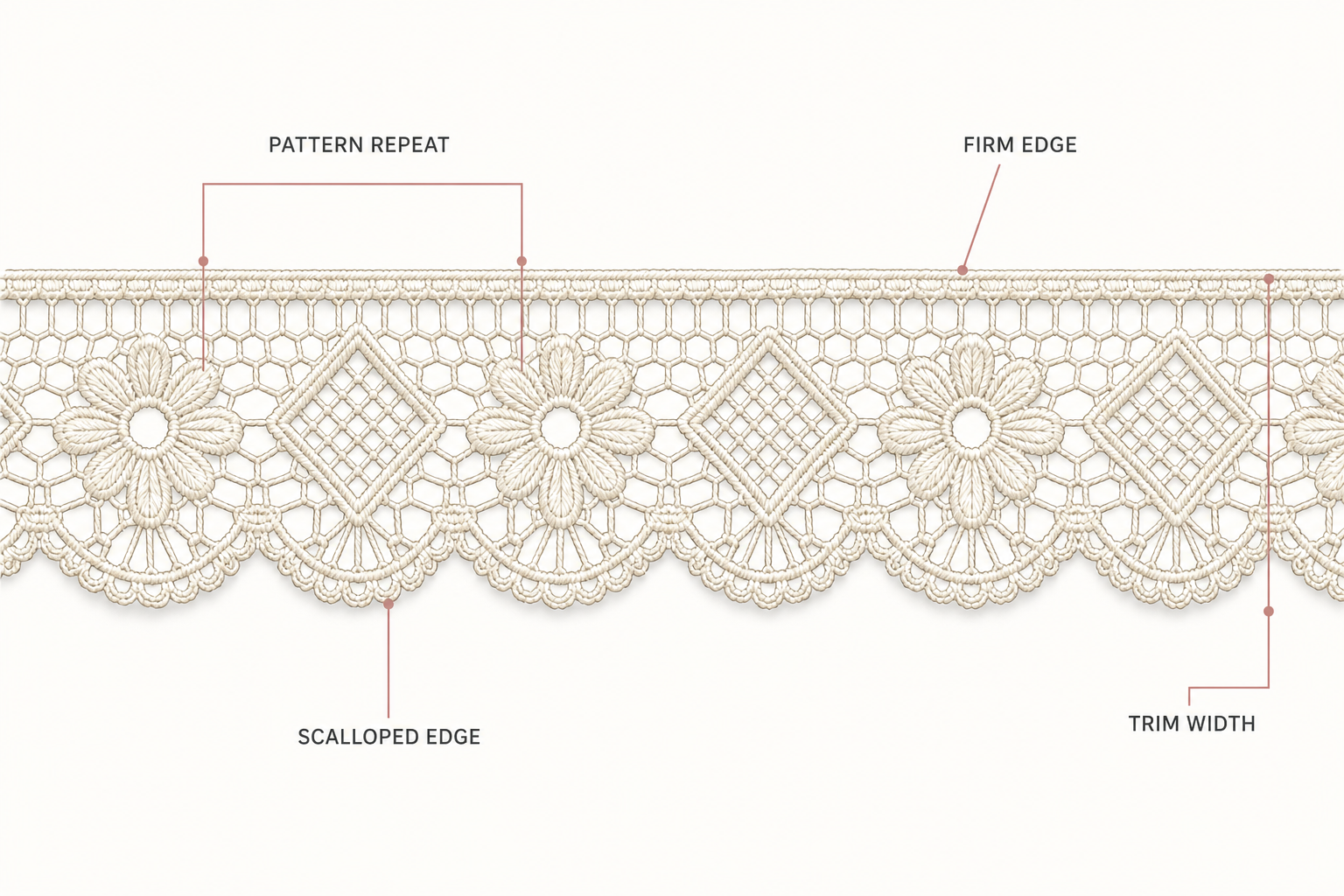
Lace fabric vs lace trim. When the machine produces a full-width patterned fabric, it is called lace fabric. When it produces a narrow patterned strip, it is called lace trim — the narrow edging and insertion material that finishes a garment.
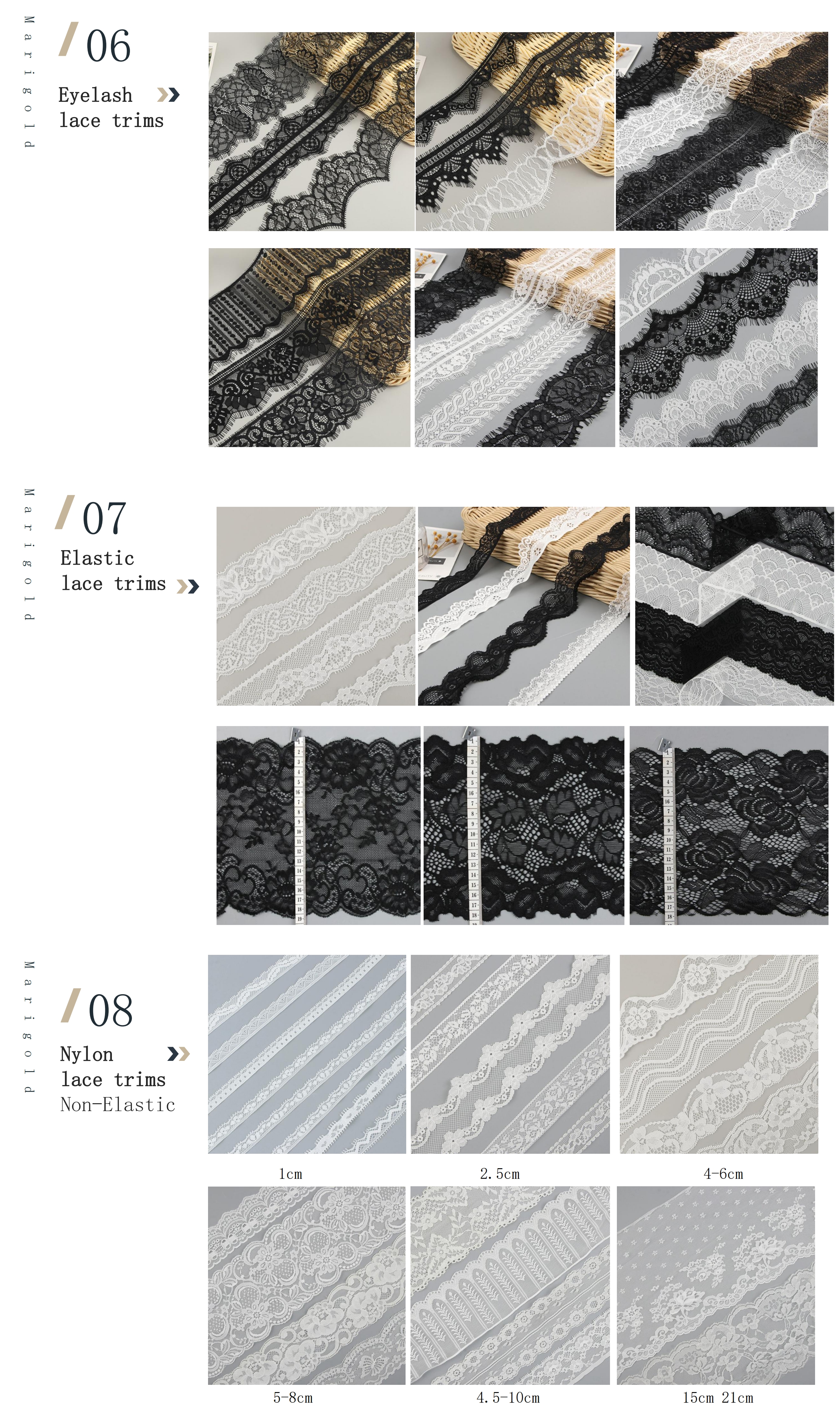
Stretch vs rigid. If spandex is knitted into the structure, the result is a stretch lace trim. If no spandex is used, it is a rigid, non-elastic lace.
That second distinction matters because it changes everything downstream: how the lace is dyed, how it must be pre-shaped, and which parts of a garment it can realistically be used on.
Step 1 — Start With the Yarn
Lace is a yarn-intensive structure. A single narrow trim may run dozens of yarn ends through the machine at once, and each end has a job.
Yarn What it contributes
Nylon / polyamide Strength, fine hand, takes dye well
Polyester Durability, cost control, colour stability
Spandex (elastane) Stretch and recovery — turns rigid lace into stretch lace
Viscose Softer, more matte look
Cotton and other natural fibres Natural hand, used in more premium and eco-positioned ranges
Metallic yarns Decorative sparkle, used in trims for evening and bridal
Because lace is built from many parallel ends running in the length direction, a single weak or inconsistent yarn lot shows up as a visible defect in the finished roll. Yarn selection is not a purchasing detail for a lace mill; it is a quality decision.
Step 2 — Warping: Where Tension Problems Begin
Before anything is knitted, the yarn must be wound onto beams. Warping prepares the yarn for the machine, and the finished warping beams feed the high-speed warp knitting and lace machines that produce lace and other elastic fabrics.
Warping is where the invisible quality of a lace order is set. Because every yarn end must arrive at the needles under the same tension, uneven warping produces pattern distortion, uneven width, or a lace that bows and waves after finishing. None of those problems can be corrected later in the dyehouse — they can only be prevented here.
Step 3 — Knitting on a Multi-Bar or Jacquard Raschel Machine
This is the stage that actually forms the lace, and it is where design freedom is created or limited.
In a multi-bar Raschel lace machine, the pattern is built by guide bars. Modern machines designed for high-end elastic lace combine a multi-bar structure with electronically controlled jacquard technology, and use servo systems to control the shog (swing) distance of the guide bars — which is what increases the range and variation of patterns a single machine can produce. Electronic yarn let-off, electronic fabric take-up and electronic batching keep the process controlled rather than manual.
The specification figures are worth knowing, because they explain cost:
Parameter Typical published specification What it means commercially
Needle type Compound needle Fine gauge, high-speed running
Bar configuration e.g. 72 pattern bars + ground bar + spandex bar + jacquard bar (75/1); or 80 pattern bars (83/1) More pattern bars = more complex motifs — and a slower, more expensive meter
Gauge E18 / E24 Finer gauge = finer patterns, lighter hand, more delicate (and more demanding) handling
Working width 134" or 200" Wider machines spread fixed costs over more meters
Max. speed up to 800 rpm Speed is only useful if the pattern and yarns allow it
Within this family of machinery, mills distinguish multibar lace machines, jacquard multibar lace machines, jacquard Raschel machines and fall-plate jacquard multibar machines. Historically the jacquard Raschel route served home textiles such as net curtains and table covers; today the same machine families are widely used for garments, hijabs and fashion textiles, alongside high-end elastic lace for intimate apparel, clothing and home decor.
Two process disciplines sit around the machine:
Pattern identity. Every new lace pattern needs its own unique ID. In good mills, a 10 cm square cloth sample is cut from the beginning of the roll and nailed to the engineering work card, so that similar-looking patterns cannot be confused during production or finishing.
Setup verification. A new pattern is not simply started and left to run. The first meters are checked for tension, stretch and appearance before the machine runs at full production speed.
Step 4 — Dyeing and Finishing
Greige lace off the machine is structurally complete but not visually finished. It has no colour, no final hand, and — critically — no final dimensions.
The simplest route is to send the greige lace straight into the dye vat and then finish and set it. That route is fast, but it produces two predictable problems: a duller colour than the approved standard, and noticeable retraction of the pattern pitch and pattern width. In other words, the lace you approved in a sample is no longer the size you received.
Better mills insert two pretreatment stages before dyeing:
Degreasing — removes knitting oils and residues, either inside the dye vat (extra procedures, longer time, higher cost) or on a dedicated flat degreasing washing machine (higher efficiency, fewer auxiliaries, less water and energy).
Pre-shaping — heat-sets the lace so that width and pattern pitch are stable before colour is applied.
Lace processed this way comes out with noticeably better colour vividness, stable dimensions, and a fuller, more three-dimensional shape. This stage is covered in detail in our separate guide to lace trim dyeing and finishing.
Step 5 — Setting, Inspecting and Packing
After dyeing, the lace passes through finishing and final setting to lock in width, hand feel and dimensional stability, then is inspected and wound into rolls with a lot record.
For lace trim specifically, the measurement that matters most is taken at the end, not the beginning: width and pattern repeat are measured on the finished, set lace. A greige sample is never a reliable reference for either.
Why the Same Design Can Quote Two Very Different Prices
When two suppliers quote the same drawing at widely different prices, the difference is usually in five places — none of which are visible on the drawing itself:
Bar count used. Building a motif with more pattern bars takes longer machine time. A simplified construction can look close on paper and cost far less.
Gauge. E24 lace is finer than E18 — finer yarns, finer patterns, slower running, more careful handling.
Yarn content. Spandex and metallic yarns raise cost. A quote without spandex is not comparable to one with it.
Dyeing and finishing route. Direct dyeing versus degreasing plus pre-shaping changes both cost and the delivered dimensions.
Order quantity and width. A narrow trim and a wide panel use the same machine differently; a small order absorbs the same setup cost over fewer meters.
This is why a price comparison on a design drawing alone is not a real comparison. The correct comparison is a like-for-like specification, confirmed on finished samples.
How to Read a Supplier's Process
Four questions will tell you more about a lace trim supplier than any catalogue:
How many guide bars does this pattern require, and can it be simplified without changing the look?
Is warping done in-house? (Uneven warping cannot be fixed later.)
Is degreasing done in the dye vat or on a flat degreasing washer, and is pre-shaping done before dyeing?
How is pattern identity controlled between similar designs in production?
A supplier who can answer these specifically is describing a process. A supplier who answers in generalities is describing a price.
FAQ
Is lace trim knitted or woven? Knitted. Lace trim is a warp-knitted product made on multi-bar or jacquard Raschel machines, which is why it can be produced in long, dimensionally stable runs at narrow widths.
What makes lace trim elastic? Spandex knitted into the structure. Lace without spandex is rigid; lace with spandex is a stretch lace trim and must be specified with its stretch and recovery behaviour.
Can I use a sample to check width and repeat before bulk? Only a finished, dyed and set sample. Greige lace relaxes during wet processing and will not give you the final measurement.
Why does my repeat length differ from the drawing? Because the drawing describes the design, not the finished construction. Repeat length depends on gauge, machine setting and the finishing route — which is why finished repeat should be written into the specification.
Does the number of bars really change the price? Yes, directly. More pattern bars mean more machine time per meter and more complex setup. Simplifying a design for a lower bar count is one of the most effective cost levers in lace trim sourcing — provided the visual result is agreed first.