Metal Stoppers and Toggles: The Small Hardware That Decides How a Garment Feels
Contact us for more details
Contact us for more details
Walk through any outerwear factory or activewear showroom and you will notice that the conversation rarely starts with the trim. Buyers discuss fabric weight, seam construction, fit blocks and dye lots. Yet when a sample comes back from the line, the first thing a merchandiser touches is usually the drawstring — and the metal stoppers and toggles at the end of it.
These components are small, inexpensive and almost invisible in a technical pack, but they carry a disproportionate share of the product's perceived quality. A hoodie with a smooth, well-weighted metal stopper feels considered. The same hoodie with a plastic barrel that slips, squeaks or cracks in the wash feels cheap, no matter how good the fleece is.
This article looks at what metal stoppers and toggles actually do, how they are specified, and how to choose them without creating problems downstream. It is written from the perspective of Guangzhou Marigold Garment accessories Ltd, a supplier of garment trims to apparel brands, trading companies and manufacturers.
The two terms are often used loosely, so it helps to separate them.
Metal stoppers — also called cord locks, cord stoppers or cord ends — are the hardware pieces that grip a drawstring and hold it at a chosen position. They are usually two-part assemblies: an outer body and an inner spring-loaded or friction-fit plunger. Press the plunger, the cord slides; release it, the cord locks. On garments they appear at the waistband of joggers, the hem of a parka, the hood of a windbreaker, the cuff of a rain shell and the neckline of a loungewear set.
Toggles — sometimes called cord toggles, duffle toggles or horn toggles, depending on shape — are the larger, often decorative pieces threaded onto a cord or elastic loop. A toggle may be purely functional (a cord end that stops the string from pulling through a channel), or it may be the closure itself, as on a duffle coat where a cord loop passes over a toggle instead of a button. In contemporary sportswear and streetwear, toggles are frequently used as styling: an oversized metal toggle at the end of a hood cord reads as a deliberate design decision rather than a functional necessity.
Both families sit in the same procurement category — garment accessories, or trims — and both are usually specified alongside aglets, eyelets, cord ends and adjustable buckles.
Plastic stoppers dominate the low-cost end of the market, and for good reason: they are light, cheap and available in any colour. Metal earns its place in four situations.
1. Weight and hand-feel. Metal has mass. A die-cast zinc alloy stopper conveys solidity in the hand that a moulded nylon part cannot match. For premium hoodies, heavyweight fleece, technical outerwear and elevated loungewear, that tactile signal is part of the value proposition.
2. Durability under heat and repeated use. Plastic stoppers are vulnerable to heat-set processes, industrial drying and repeated tension cycles; the spring weakens and the grip slips. Properly finished metal hardware resists deformation and holds its clamping force far longer.
3. Surface finish as a design element. Metal can be plated, electrophoretically coated, brushed, antiqued or painted. The same stopper body can read as bright jewellery-like nickel, stealth matte black, warm antique brass or gunmetal grey — a range of aesthetics that one plastic mould cannot deliver.
4. Consistency across a collection. When a brand uses metal eyelets, metal aglets, metal zip pulls and metal stoppers, the hardware reads as a single family. Mixed materials across a garment are one of the fastest ways to make a well-made product look assembled from whatever was in stock.
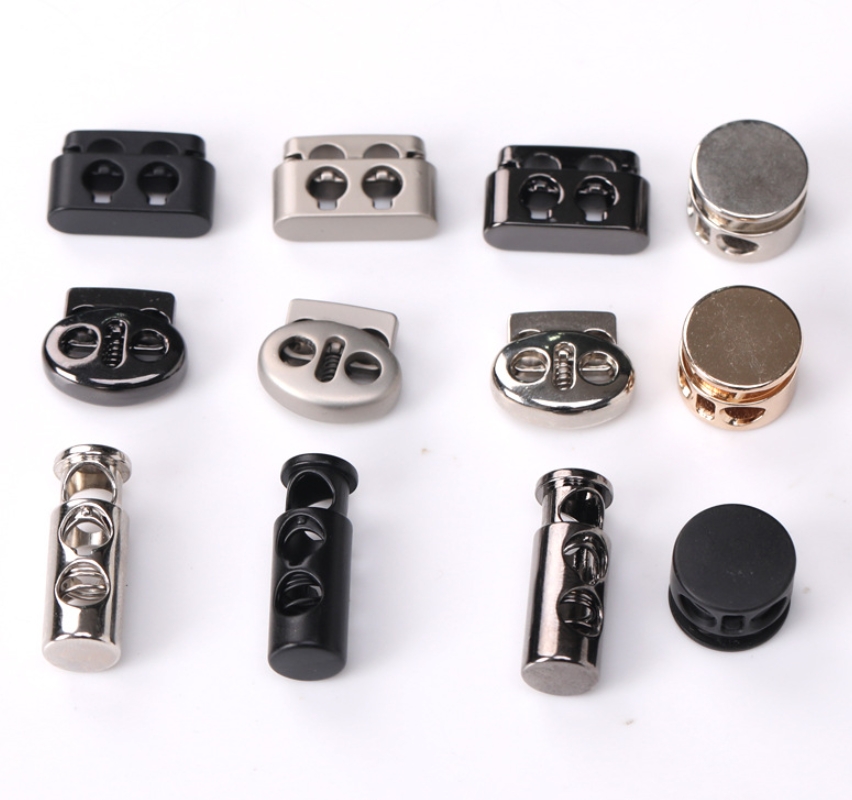
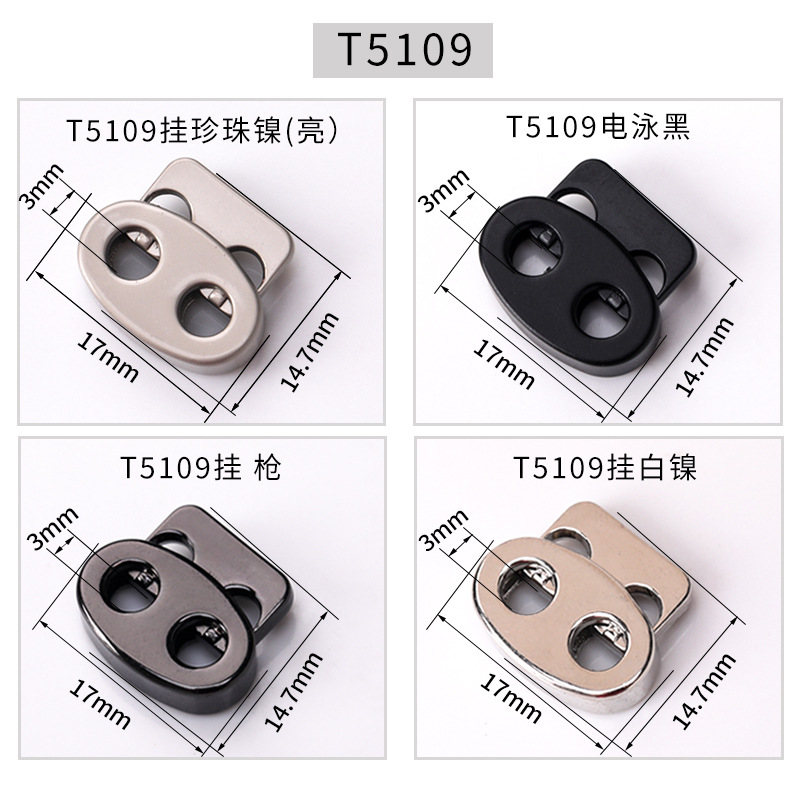
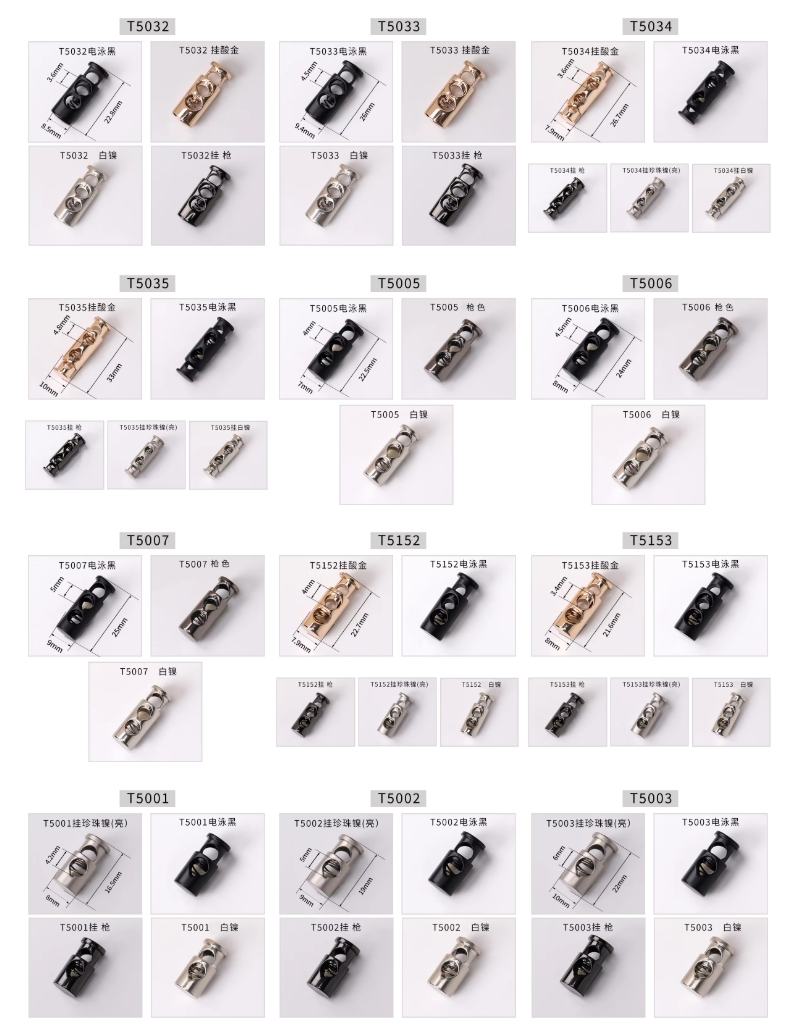
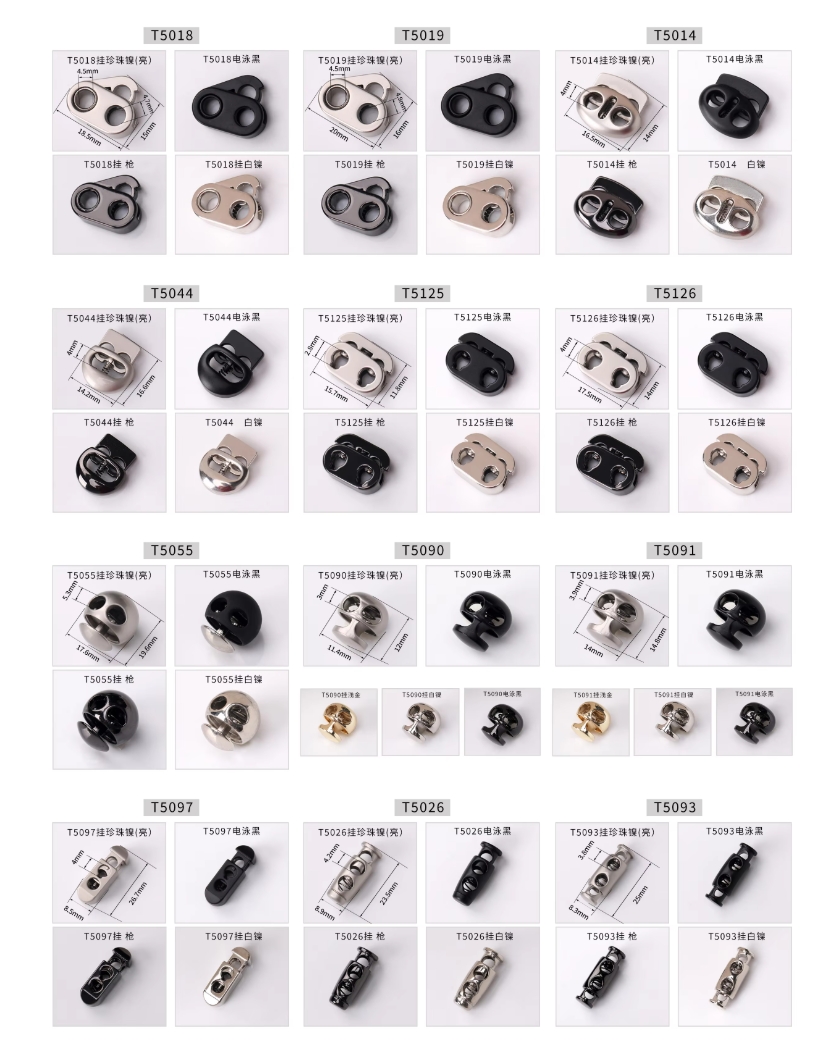
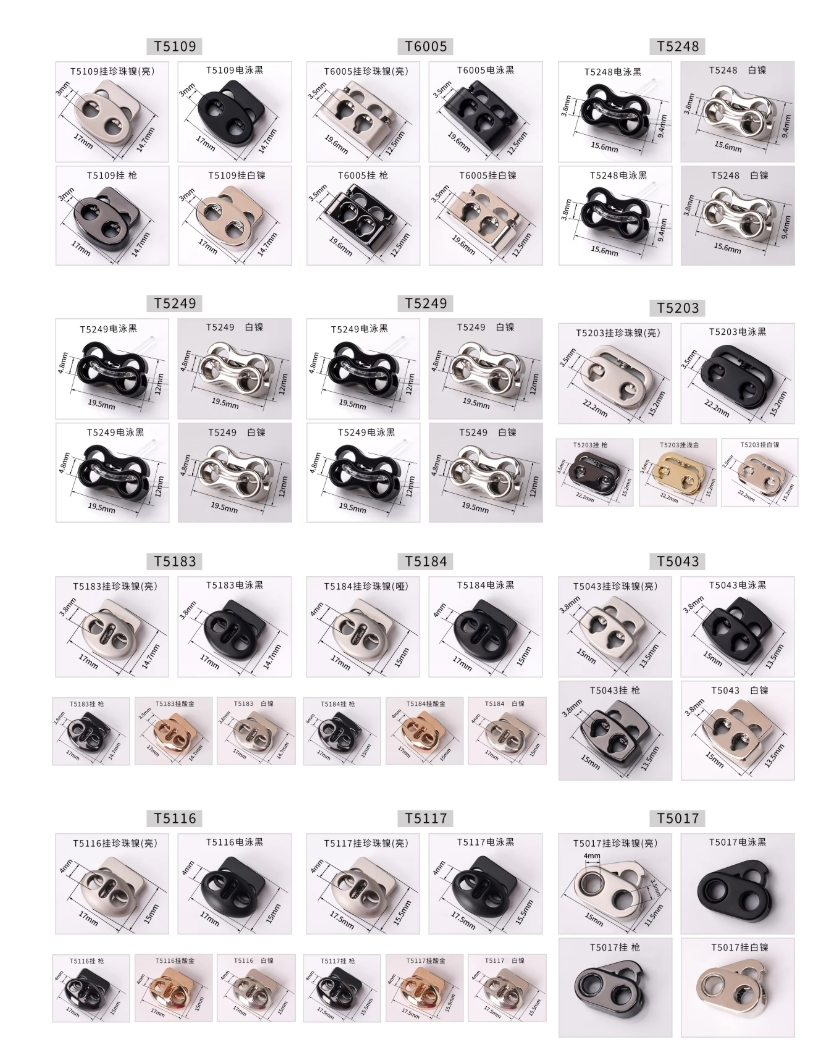
A typical supplier catalogue is organised by body shape and finish rather than by garment type, because the same body is reused across many end uses. In the Guangzhou Marigold Garment accessories Ltd range, for example, the metal stopper and toggle programme is grouped into model families such as T5109, T6005, T5248, T5249, T5203, T5183, T5184, T5043, T5116, T5117 and T5017.
Within each family, the important variables are:
Body geometry — single-hole or double-hole; round, oval, rectangular or saddle-shaped; flat-back or contoured. Double-hole bodies are usually chosen where two cord ends must be adjusted together, as on a hood.
Plunger style — top-press, side-press or twist-lock. Top-press is the most common on apparel; side-press is easier to operate with gloves, which makes it popular on outerwear and workwear.
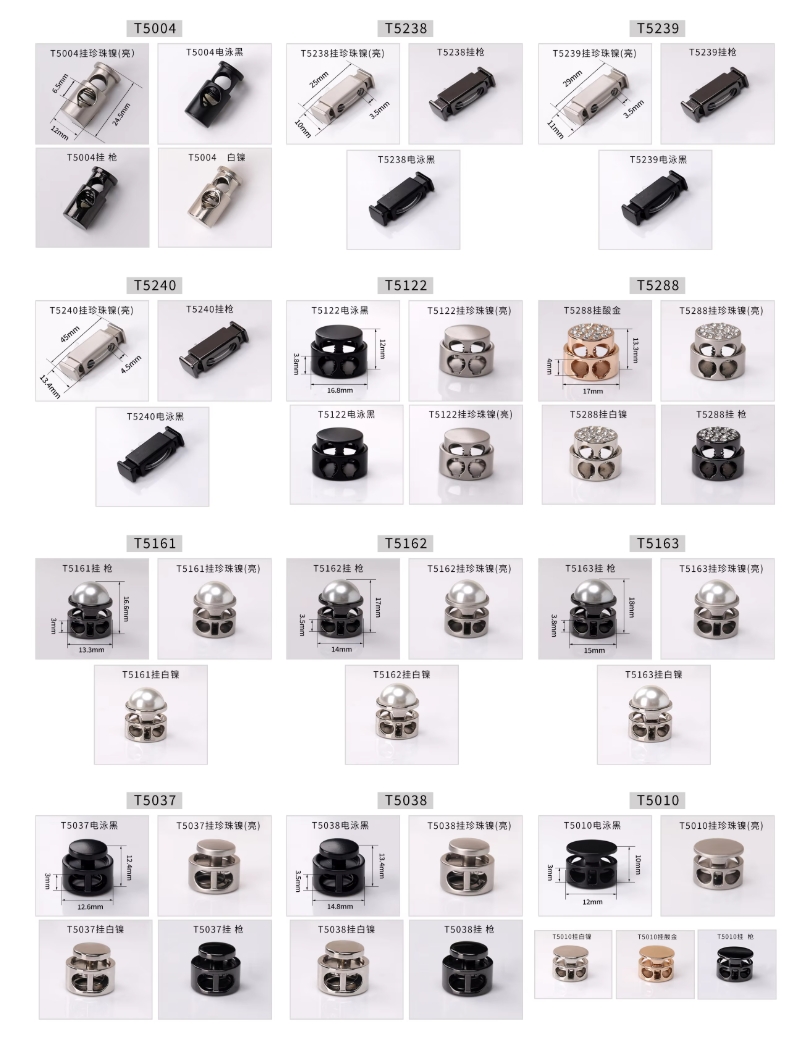
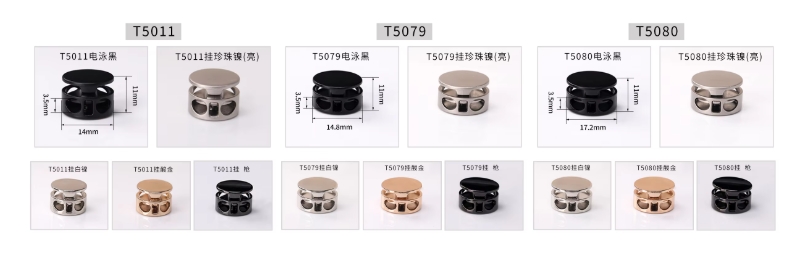
Finish — the catalogue finishes include pearl nickel (bright), white nickel, gunmetal and electrophoretic black. Pearl and white nickel give a polished, jewellery-adjacent look for fashion and premium casualwear; gunmetal and electrophoretic black suit technical, military-inspired and streetwear ranges and hide scratches better in wear.
Scale — from compact 17 mm-class bodies for lightweight drawcords to larger 20 mm-plus bodies with more visible presence. Scale should be chosen against cord diameter and against the visual weight of the garment, not in isolation.
Compatibility — the internal channel must match the cord: too loose and the stopper slides under load, too tight and it abrades the cord and eventually frays it.
Toggles deserve separate attention because they are judged differently. A stopper is evaluated on function — does it hold, does it release smoothly, does it survive laundering. A toggle is evaluated on silhouette.
In practice, the toggle decision usually comes down to three questions:
Is it a closure or a cord end? A duffle-style closure toggle needs a smooth, low-friction surface and a shape that will not snag the loop. A cord-end toggle mainly needs to be heavy enough to hang correctly and to have no sharp edges where the cord exits.
Does the finish match the rest of the hardware? Toggles sit close to eyelets and zip pulls on the garment, so finish consistency matters more than it does for a hidden stopper.
What does it do to the drape? A heavy metal toggle at the end of a fine cord pulls the cord straight and changes how the hood or hem falls. On lightweight fabrics, that can be a design plus or an unintended distortion.
Most quality complaints about metal stoppers and toggles trace back to something that was never written into the specification. It is worth building these into the tech pack from the start.
Base material and plating thickness. Zinc alloy is the common base for die-cast bodies. Plating thickness and the number of coating layers determine how the finish performs in wear and in salt-spray or perspiration exposure. Two visually identical stoppers can behave very differently after twenty washes.
Nickel release. Metal hardware that contacts skin — particularly at the neckline and waist — may be subject to nickel release limits in several markets. If the end product is sold into those markets, request the relevant test documentation before production rather than after.
Sharp edges and cord wear. Run a cord through the assembled stopper and cycle it repeatedly. A burr inside the channel will show up as fuzzing within a few hundred cycles — far cheaper to find in the sample room than in a customer complaint.
Colour consistency between lots. Plated finishes vary subtly between batches. If a collection ships in several drops, ask for retained colour standards and specify the tolerance for a colour match.
Assembly and pull force. Spring tension should be specified as a target range. Too weak and the stopper creeps under load; too strong and the customer cannot operate it one-handed.
Laundering and chemical resistance. Household washing, industrial laundry, dry cleaning and garment dyeing all attack different finishes. State the care regime the product will actually face, not the most convenient one.
Three practical points tend to decide whether a trim order runs smoothly.
Sample against the real cord. A stopper approved on a bench with a 3 mm sample cord may fail on the production cord if the supplier substitutes a different braid or diameter. Send the actual cord, or specify it precisely.
Confirm the finish on the actual body. Finish swatches on a flat plate do not always translate to a curved, die-cast body. Ask for a finished sample in the production finish, not a plating chip.
Lock the standard before bulk. Once a finish and a pull force are approved, retain the approved sample and reference it in the purchase order. Verbal approvals are the most common source of disputes on small hardware.
Guangzhou Marigold Garment accessories Ltd supplies garment accessories — including metal stoppers, toggles, cord ends, eyelets and related trims — to apparel brands, sourcing agents and garment manufacturers. The company works from Guangzhou, one of the densest garment and trim supply clusters in the world, which allows short development cycles and close coordination with the factories that will eventually sew the hardware into the finished garment.
The metal stopper and toggle programme covers a broad range of body shapes and finishes — pearl nickel, white nickel, gunmetal and electrophoretic black among them — so that a single collection can be developed with consistent hardware rather than assembled from mismatched parts. Custom development is available for buyers who need a specific silhouette, finish or logo treatment.
For buyers evaluating metal stoppers and toggles, the most useful first step is usually a conversation about the end product: the fabric, the cord, the care label, the market and the price point. Those five inputs narrow a catalogue of hundreds of bodies down to a handful worth sampling.
Metal stoppers and toggles will never appear on the cover of a lookbook, but they are one of the few places where a garment's price point is communicated by touch rather than by label. Specifying them properly — base material, plating, pull force, cord compatibility, care regime — costs very little at the development stage and prevents most of the failures that show up eighteen months later in returns data.
Guangzhou Marigold Garment accessories Ltd welcomes enquiries from brands and manufacturers who want to specify metal stoppers and toggles with that level of detail, and to build a hardware family that holds together across a full collection.